Learning Spanish goes far beyond memorizing vocabulary lists, filling out grammar workbooks, and taking standard tests. While those foundational elements are undeniably important for grasping the mechanics of the language, the ultimate goal for most learners is real, human connection. You want to speak confidently, understand native speakers with ease, and engage in real life without hesitation. That is exactly why discovering how to improve conversation skills in Spanish is one of the most rewarding and transformative steps in your entire language-learning journey.
When you prioritize speaking over passive reading, you open the door to a richer cultural experience. In this comprehensive guide, we will explore practical, proven ways to build your confidence and become a more natural, fluid speaker. The true secret to long-term success is consistent, enjoyable exposure that does not feel like studying. Whether you love binge-watching dramatic telenovelas, listening to fast-paced podcasts, or chatting with friends over a cup of coffee, there is a perfect strategy waiting for you.
Why Focus on Conversation From Day One?
When you finally step out of the traditional textbook and into the vibrant, real world, the language truly comes alive. The best way to improve your Spanish conversation skills involves actively engaging with native speakers and consuming authentic, everyday media. This immersive approach helps you pick up on the natural rhythm, local slang, and subtle cultural nuances that traditional study methods almost always miss.
Think about how children learn to speak their native tongue. They listen intently, mimic the sounds they hear, make countless mistakes, and simply try again without fear of embarrassment. By actively prioritizing Spanish conversation skills, you naturally internalize complex grammar rules without overthinking them. This shift in mindset moves your focus away from achieving perfect, robotic accuracy and instead points you toward making genuine, meaningful connections with the people around you. You will find that fluency is not about knowing every word in the dictionary; it is about communicating your thoughts effectively and understanding others.
Creating an Immersion Environment at Home
You absolutely do not need to pack your bags and move to a Spanish-speaking country to surround yourself with the language. Building a powerful immersion environment right in your daily life is highly effective and surprisingly easy to do. Start by switching the default language on your smartphone and social media accounts to Spanish. This forces you to interact with the language every single time you pick up your device. Additionally, try listening to Spanish podcasts during your daily commute or watching your favorite shows fully dubbed in Spanish instead of relying on English subtitles.
This specific type of passive learning is incredibly powerful because it trains your brain to process the language in the background. As you consistently expose yourself to the natural flow, intonation, and speed of the language, improving your conversational Spanish becomes significantly less of a chore and much more of an entertaining, daily habit. Over time, you will start to recognize common conversational phrases, understand cultural references, and respond more instinctively when spoken to.
Practical Strategies for Every Type of Learner
If you are constantly wondering how to practice your Spanish speaking skills on a daily basis without getting bored or overwhelmed, the answer is finding consistency in activities you genuinely enjoy. Here are a few proven, highly effective methods that you can start using today:
First, try the shadowing technique. Shadowing requires you to listen to a native speaker—perhaps on a podcast or YouTube video—and repeat after them as closely as possible in real time. This exercise is fantastic because it helps perfect your pronunciation, improves your pacing, and fine-tunes your natural intonation. It teaches your mouth muscles to form the sounds correctly without the pressure of coming up with the vocabulary yourself.
Second, consider joining language exchanges. You can easily find a dedicated conversation partner online through various language apps or in your local community. You can practice your conversation skills in Spanish for half of the session, and then help them practice their English for the other half. It is a mutually beneficial setup that often leads to lasting friendships and deep cultural exchanges.
Finally, embrace the habit of self-talk. Narrate your daily activities out loud in Spanish as you go about your day. For example, describe what you are cooking for dinner or explain the steps you are taking to clean your house. It might sound silly at first, but it actively forces your brain to recall vocabulary on the spot and construct sentences without the safety net of a dictionary.
By actively searching for practical opportunities to converse in your daily life and applying these strategies, you train your brain to think directly in the target language rather than constantly translating from English first. This is the critical leap between beginner-level translation and true, conversational fluency.
The Power of Analyzing Real Dialogues
One of the most effective ways to accelerate your learning is by studying real, contextual dialogues. Textbooks often provide stiff, unnatural sentences, but authentic conversations show you how people actually speak. Studying these examples is fantastic practice for your Spanish conversation skills. Below, we have outlined five beginner-friendly scenarios that showcase natural, everyday communication.
1. Ordering Food at a Local Restaurant
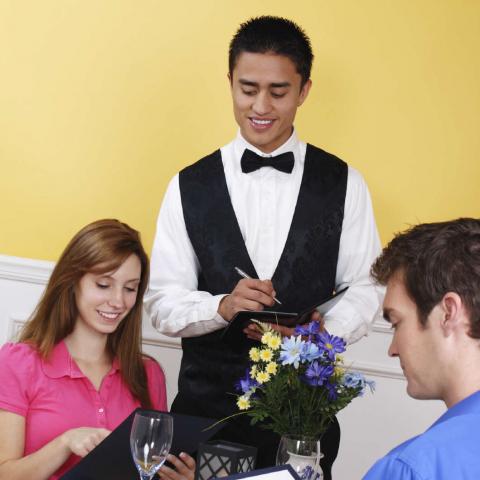
Dining out is one of the most common situations you will encounter when traveling. This exchange shows a polite and straightforward way to request a table and order a beverage.
Mesero: ¡Hola! ¿Qué le puedo traer hoy?Cliente: Hola, quisiera pedir una mesa para dos, por favor. Y para tomar, un agua mineral.Mesero: Claro que sí, enseguida se lo traigo.
English:Waiter: Hello! What can I bring you today?Customer: Hello, I would like to request a table for two, please. And to drink, a mineral water.Waiter: Of course, I will bring it right away.
2. Asking for Directions on the Street

Getting lost happens to the best of us. Knowing how to politely ask a local for directions and understanding their response is an essential survival skill.
Turista: Disculpe, ¿sabe dónde está la estación de tren?Local: Sí, siga derecho por esta calle y gire a la derecha en la próxima esquina. Está a dos cuadras.Turista: ¡Muchas gracias por su ayuda!
English:Tourist: Excuse me, do you know where the train station is?Local: Yes, go straight down this street and turn right at the next corner. It is two blocks away.Tourist: Thank you very much for your help!
3. Making Weekend Plans with a Friend

Socializing is the heart of language learning. This casual conversation demonstrates how to make plans, suggest an activity, and agree on a time.
Ana: ¡Hola Carlos! ¿Qué vas a hacer este fin de semana?Carlos: No tengo planes todavía. ¿Quieres ir al cine el sábado?Ana: ¡Me parece una gran idea! Nos vemos allí a las seis.
English:Ana: Hello Carlos! What are you going to do this weekend?Carlos: I do not have plans yet. Do you want to go to the movies on Saturday?Ana: That sounds like a great idea to me! See you there at six.
4. Shopping for Fresh Produce at a Market
Interacting with vendors at a local market is a great way to practice numbers, pleasantries, and basic commerce vocabulary in a fast-paced environment.
Vendedor: ¡Buenos días! ¿En qué le puedo ayudar?Comprador: Buenos días. ¿Cuánto cuestan estas manzanas?Vendedor: Cuestan cincuenta pesos el kilo. Son muy dulces.
English:Vendor: Good morning! How can I help you?Buyer: Good morning. How much do these apples cost?Vendor: They cost fifty pesos a kilo. They are very sweet.
5. Introducing Yourself at a Social Gathering

Meeting new people can be intimidating, but a warm, simple introduction breaks the ice immediately. This is a classic example of starting a brand new connection.
Laura: ¡Hola! Soy Laura. Creo que no nos conocemos.David: ¡Hola Laura! Soy David, un amigo de Juan. Mucho gusto.Laura: El gusto es mío. ¿De dónde eres, David?
English:Laura: Hello! I am Laura. I do not think we have met.David: Hello Laura! I am David, a friend of Juan. Nice to meet you.Laura: The pleasure is mine. Where are you from, David?
Taking the Next Step Toward Fluency
Improving your ability to speak confidently and fluidly certainly takes time, patience, and dedicated practice, but it is entirely within your reach. The journey to fluency does not have to be a grind. Focus on what you genuinely enjoy doing, whether that is listening to upbeat music, watching dramatic movies, or chatting with native speakers online. The more you immerse yourself in the culture and the language, the faster you will see real, tangible progress.
If you are completely ready to take your conversational fluency to the next level and discover exactly how to improve your Spanish speaking skills with structured, engaging, and professional guidance, we have the perfect tools waiting for you. Dive into our comprehensive library of audio and video lessons. Create your free lifetime account and start speaking from your very first lesson today at SpanishPod101.com.