You could spend several days exploring Mexico City alone, but head south and you’ll find ancient Maya cities, markets selling regional food, and beaches along the Caribbean coast.
If you’re planning your first trip, this guide covers ten of the best places to visit in Mexico, what to see when you get there, and useful Mexican Spanish to learn before you go. Each section includes a phrase you can use on the spot, and at the end you’ll find practical phrases for buying tickets, asking for directions, and visiting museums and archaeological sites.
Top 10 Places to Visit in Mexico at a Glance
| Destination | State | Best for |
| Mexico City | Ciudad de México | Museums, history, food |
| Teotihuacán | State of Mexico | Pyramids, day trip from the capital |
| Chichén Itzá | Yucatán | Maya ruins |
| Cancún, Tulum, and the Riviera Maya | Quintana Roo | Beaches, cenotes |
| Oaxaca and Monte Albán | Oaxaca | Food, festivals, Zapotec ruins |
| Palenque | Chiapas | Maya ruins in the rainforest |
| Guadalajara | Jalisco | Mariachi, tequila, murals |
| Guanajuato | Guanajuato | Colonial streets, festivals |
| Taxco | Guerrero | Silver, colonial architecture |
| Copper Canyon | Chihuahua | Nature, train journeys |
Table of Contents
- Mexico City
- Teotihuacán
- Chichén Itzá
- Cancún, Tulum, and the Riviera Maya
- Oaxaca and Monte Albán
- Palenque
- Guadalajara
- Guanajuato
- Taxco
- Copper Canyon
- Spanish Phrases for Sightseeing in Mexico
- Spanish Travel Vocabulary for Mexico
- Quiz: How Well Do You Know Mexico’s Top Destinations?
- Places to Visit in Mexico: FAQ
- Final Thoughts
1. Mexico City

Mexico City, la Ciudad de México or CDMX, stands on the site of Tenochtitlan, the island city the Mexica (Aztecs) founded in Lake Texcoco in the 14th century. The remains of its main temple, the Templo Mayor, were excavated after electricity workers found a huge carved stone of the goddess Coyolxauhqui in 1978. Today, you can visit the ruins and their museum a short walk from the main square.
That square is the Zócalo, officially called the Plaza de la Constitución. On one side is the Palacio Nacional (National Palace), where Diego Rivera’s murals show scenes from Mexican history. On another is the Metropolitan Cathedral. Farther out, you can spend a day in Chapultepec Park and the National Museum of Anthropology, or ride a painted boat called a trajinera along the canals of Xochimilco.
Mexico City’s markets and street food stands are good places to put your Spanish into practice. Start with something simple, such as asking how much a taco costs or ordering food to take away:
Try it in Spanish
| ¿A cómo están los tacos? | How much are the tacos? |
| Dos de pastor, por favor. | Two al pastor tacos, please. |
| Para llevar, por favor. | To go, please. |
For a quick introduction to other big cities, watch Alex’s video lesson Major Mexican Cities.
2. Teotihuacán

Teotihuacán is about 50 kilometers northeast of central Mexico City. Buses leave from the Terminal del Norte bus station, and the trip usually takes about an hour, depending on traffic. The site’s main street, the Calzada de los Muertos (Avenue of the Dead), runs past the Pirámide del Sol (Pyramid of the Sun) and ends at the smaller Pirámide de la Luna (Pyramid of the Moon).
In the first centuries CE, Teotihuacán was one of the largest cities in the Americas. By the time the Aztecs arrived, it had been abandoned for hundreds of years, and the name we use today is the one they gave it in Nahuatl. Archaeologists have learned a lot about how people lived there, but we still don’t know what language they spoke or what they called their city. The SpanishPod101 lesson puts it simply: Nadie sabe quién construyó Teotihuacán originalmente (“Nobody knows who originally built Teotihuacán”).
The site is large and has little shade, so arrive early and bring water and sun protection. Before you leave, check when the last bus goes back: ¿A qué hora sale el último camión a la Ciudad de México? (“What time does the last bus to Mexico City leave?”).
See Mexico’s top attractions in Spanish
In the video lesson Top 10 Tourist Attractions in Mexico, a native speaker introduces Teotihuacán, Palenque, Chichén Itzá, and more, with an example sentence in Spanish for each one.
Watch the Video Lesson3. Chichén Itzá

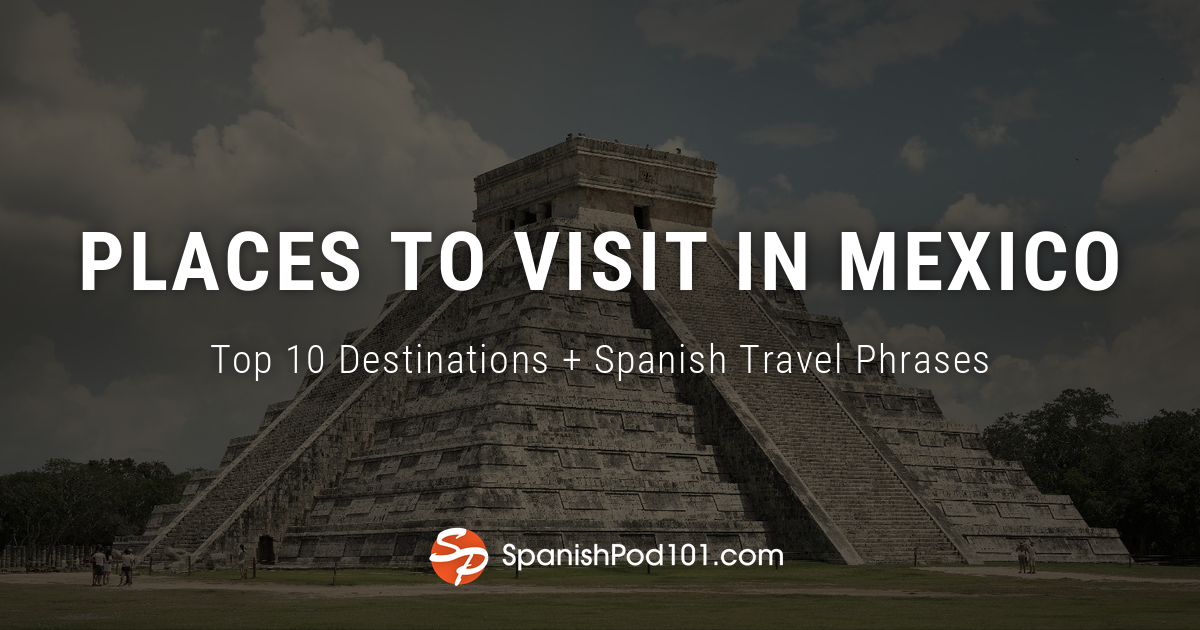
Chichén Itzá, in the state of Yucatán, was one of the largest Maya cities of its time and is a UNESCO World Heritage Site. Its central pyramid, El Castillo, is also called the Temple of Kukulcán, after the feathered serpent deity. It rises about 30 meters in nine stepped levels, with a staircase on each side. In 2007, Chichén Itzá was chosen as one of the New Seven Wonders of the World in an international public vote.
In the days around the spring and fall equinoxes, the late-afternoon sun casts a row of triangular shadows along the north staircase, which ends in carved serpent heads. Together, they look like a snake moving down the pyramid, and thousands of people come to watch. Researchers still debate whether the Maya designed the building to create this effect or whether it’s a coincidence.
Valladolid is the closest town, about 45 minutes away by road. From Mérida, allow roughly two hours, and from Cancún, two and a half to three hours. To check the opening time, ask: ¿A qué hora abre la zona arqueológica? (“What time does the archaeological site open?”).
4. Cancún, Tulum, and the Riviera Maya

Mexico’s Caribbean coast is in the state of Quintana Roo, and each place along it has a different character:
- Cancún is known for its hotel zone, a long strip of resorts between the sea and a lagoon, and for its nightlife. It also has the region’s main international airport.
- The Riviera Maya is the stretch of coast south of Cancún, roughly from Puerto Morelos to Tulum.
- Playa del Carmen is a beach town centered on la Quinta Avenida, a long pedestrian street of shops and restaurants. Ferries leave from here for Cozumel.
- Cozumel is an island popular with divers and snorkelers for its coral reefs, and it’s also a major cruise ship stop.
- Tulum has a walled Maya site on a cliff above the sea, and a beach area with small hotels.
Across the Yucatán Peninsula, you’ll also find cenotes. These are sinkholes that formed when limestone collapsed and exposed groundwater. Some are open pools, and others are partly or fully underground in caves. The word comes from the Yucatec Maya ts’ono’ot, a word for a place with accessible water. Many cenotes are open for swimming, but some are protected or for viewing only, and many ask visitors to shower first and avoid sunscreen to protect the water.
Before you get in, ask: ¿Se puede nadar en este cenote? (“Can you swim in this cenote?”) or ¿Hay que usar chaleco salvavidas? (“Do you have to wear a life jacket?”).
5. Oaxaca and Monte Albán

Oaxaca is both a state and its capital city, officially Oaxaca de Juárez. The city is known for its food, crafts, and festivals.
In Mexico, mole isn’t one sauce but a family of sauces, usually made with chilies, spices, and many other ingredients. Oaxaca is famous for several kinds, including the dark mole negro and the reddish mole coloradito. Also try a tlayuda, a large, thin tortilla toasted until crisp and topped with beans, asiento (unrefined pork lard), Oaxaca cheese, and often meat.
If you’re not sure what to order, ask: ¿Qué mole me recomienda? (“Which mole do you recommend?”) or ¿Pica mucho? (“Is it very spicy?”).
Every July, the city hosts the Guelaguetza, also called the Lunes del Cerro (“Mondays on the Hill”). On the two Mondays after July 16, dance groups from across the state perform in an open-air auditorium on the Cerro del Fortín, above the city. Oaxaca is also a popular place to experience the Day of the Dead at the end of October and the start of November; read more in our guide to the Day of the Dead in Mexico.
Just outside the city, Monte Albán sits on a leveled mountaintop above the Valley of Oaxaca. Founded around 500 BCE, it was the main Zapotec city for more than a thousand years. As the SpanishPod101 lesson describes it: La ciudad de Monte Albán está en la cima de un monte (“The city of Monte Albán is on top of a mountain”). The site and Oaxaca’s historic center are together a UNESCO World Heritage Site.
6. Palenque

The Maya city of Palenque, in the state of Chiapas, stands at the edge of the rainforest. The SpanishPod101 lesson describes it as Palenque está en una jungla (“Palenque is in a jungle”). In everyday Mexican Spanish, you’ll also hear la selva: Palenque está en la selva de Chiapas.
Its best-known building is the Temple of the Inscriptions, the funerary monument of the king K’inich Janaab’ Pakal, who ruled Palenque in the 7th century. The temple is named for its long hieroglyphic texts. In 1952, the Mexican archaeologist Alberto Ruz Lhuillier reached Pakal’s tomb at the bottom of a hidden staircase inside the pyramid.
Much of the site is still surrounded by trees, and you may hear howler monkeys. Local guides offer tours at the entrance, so it’s useful to ask: ¿Cuánto cuesta el recorrido con guía? (“How much is the guided tour?”) and ¿El recorrido es en español o en inglés? (“Is the tour in Spanish or English?”).
7. Guadalajara

Guadalajara is one of Mexico’s largest cities and the capital of Jalisco. The state is closely linked with two Mexican traditions. Mariachi music developed in western Mexico, and UNESCO added it to its list of Intangible Cultural Heritage in 2011. Tequila is a spirit made from blue agave and named after the town of Tequila, about an hour’s drive northwest of Guadalajara, where the agave fields are also a UNESCO World Heritage Site.
In the city center, visit the cathedral and the Hospicio Cabañas. Bishop Juan Cruz Ruiz de Cabañas founded it in the early 1800s as a home for orphans, older people, and the sick, and it’s now a museum and a UNESCO World Heritage Site. In its chapel, José Clemente Orozco painted a series of murals in the late 1930s, including El hombre de fuego (The Man of Fire) in the dome.
If you want to hear live music, ask: ¿Dónde puedo escuchar mariachi en vivo? (“Where can I hear live mariachi?”).
8. Guanajuato

Guanajuato grew rich from its silver mines during the colonial period, and its historic center and nearby mines are a UNESCO World Heritage Site. The city fills a narrow valley, so its houses climb the hillsides, and many of its alleys are too narrow or steep for cars.
Underneath the center is a network of tunnels. They were first built to control the Guanajuato River, which used to flood the city. After a dam was built upstream, the old riverbed and tunnels were turned into roads, so much of the traffic now runs underground.
One famous alley is the Callejón del Beso (Alley of the Kiss), which is only about 70 centimeters wide at its narrowest point. According to local legend, two young lovers whose families kept them apart used to meet on facing balconies here. To find it, ask: ¿Por dónde se llega al Callejón del Beso? (“How do you get to the Alley of the Kiss?”).
Every October, Guanajuato hosts the Festival Internacional Cervantino, an international arts festival with theater, music, and dance.
9. Taxco

Taxco, in the state of Guerrero, is a hillside town of white houses, red roofs, and steep cobblestone streets. Silver has been mined in the area since the 16th century, and today the town is known for its silver jewelry and crafts. Taxco is one of Mexico’s Pueblos Mágicos (“Magical Towns”), a title the Ministry of Tourism gives to towns with special historic or cultural value.
The town’s landmark is the Templo de Santa Prisca, a pink-stone church with two tall towers, built in the 1750s by the silver miner José de la Borda. Take a virtual walk through the town in the video lesson The Magical Town of Taxco – Exploring Mexico.
When you shop for silver, ask: ¿Es plata 925? (“Is it 925 silver?”). Sterling silver is usually stamped with the number 925.
10. Copper Canyon
In the Sierra Tarahumara mountains of Chihuahua, the Copper Canyon, or Barrancas del Cobre, is a system of several deep canyons. It’s often compared with the Grand Canyon in the US. The region is home to the Rarámuri (Tarahumara) people, who are known for running long distances.
Many visitors see it by train. The Ferrocarril Chihuahua al Pacífico, known as El Chepe, runs between the city of Chihuahua and Los Mochis, near the Pacific coast, crossing bridges and tunnels through the mountains. The Chepe Express covers the section between Creel and Los Mochis, and it stops at Divisadero, a viewpoint over the canyons. To buy a ticket, you could say: Un boleto a Creel, por favor (“One ticket to Creel, please”).
Spanish Phrases for Sightseeing in Mexico
You can travel around Mexico without perfect Spanish, but these phrases will help you buy tickets, find your way, and visit museums and archaeological sites:
| Spanish | English |
|---|---|
| ¿Dónde está la taquilla? | Where is the ticket office? |
| Un boleto, por favor. | One ticket, please. |
| ¿Cuánto cuesta la entrada? | How much is the entrance fee? |
| ¿A qué hora abre / cierra? | What time does it open / close? |
| ¿Se pueden tomar fotos? | Can you take photos? |
| ¿Cómo llego a la zona arqueológica? | How do I get to the archaeological site? |
| ¿Está lejos de aquí? | Is it far from here? |
| ¿Hay visitas guiadas en inglés? | Are there guided tours in English? |
| ¿Qué me recomienda visitar? | What do you recommend I visit? |
| ¿De dónde sale el camión a…? | Where does the bus to… leave from? |
Mexican Spanish tip
In Mexico, a ticket is usually un boleto. In Spain, you’ll hear un billete or una entrada instead. Mexicans also often call a bus un camión, although you’ll see autobús on signs and at bus stations.
To practice, listen to the lessons Asking Directions in Mexican Spanish and Long-distance Bus Trips in Mexico. For phrases for hotels, restaurants, and emergencies, see our Spanish travel phrases guide.
Spanish Travel Vocabulary for Mexico
| Spanish | English |
|---|---|
| el viaje | trip |
| la playa | beach |
| la pirámide | pyramid |
| la zona arqueológica | archaeological site |
| las ruinas | ruins |
| el centro histórico | historic center |
| el mercado | market |
| el museo | museum |
| la iglesia | church |
| la selva | rainforest, jungle |
| el cenote | cenote (natural sinkhole pool) |
| el pueblo mágico | “magical town” |
| la excursión | day trip, tour |
Practice: talk about your trip in Spanish
| Quiero visitar Chichén Itzá. | I want to visit Chichén Itzá. |
| Este verano voy a ir a Oaxaca. | This summer, I’m going to go to Oaxaca. |
| Mi lugar favorito de México es Guanajuato. | My favorite place in Mexico is Guanajuato. |
Say each sentence out loud, then change the place to the one you most want to visit.
Getting ready for your first trip? The video lesson 10 Ways to Prepare for Travel to Mexico has practical tips, and the culture lesson Tourism in Mexico explains how important tourism is to the country’s economy.
Quiz: How Well Do You Know Mexico’s Top Destinations?
Choose an answer for each question. Tap an answer to see if you’re right.
Question 1. Which Maya site was chosen as one of the New Seven Wonders of the World in 2007?
Question 2. What is a cenote?
Question 3. How do you usually say “ticket” in Mexico?
Places to Visit in Mexico: FAQ
What are the best places to visit in Mexico for a first trip?
Many first-time visitors combine Mexico City and a day trip to Teotihuacán with either the Yucatán Peninsula (Chichén Itzá, Cancún, and Tulum) or Oaxaca. That gives you a mix of city life, ancient sites, regional food, and, if you choose the Yucatán, beaches.
When is the best time to visit Mexico?
It depends on the region, but the dry season, roughly from November to April, is a popular time to visit most of the country. The Atlantic hurricane season runs from June to November, so check the forecast if you’re traveling to the Caribbean coast during those months.
Do I need to speak Spanish to travel in Mexico?
Not always. In big tourist areas like Cancún, many people working in hotels and restaurants speak English. In smaller towns, markets, and on buses, Spanish is much more useful, and even basic phrases make it easier to ask for directions, order food, and buy tickets.
What is a Pueblo Mágico?
A Pueblo Mágico (“Magical Town”) is a title that Mexico’s Ministry of Tourism gives to towns with special historic, cultural, or natural value. Taxco is one of them.
Final Thoughts
These ten places to visit in Mexico cover very different trips: Aztec and Maya history in Mexico City, Teotihuacán, Chichén Itzá, and Palenque; food and festivals in Oaxaca; colonial silver towns like Guanajuato and Taxco; the Caribbean coast; and the mountains of the Copper Canyon. Learning even a little Mexican Spanish before you go will help you buy tickets, ask for directions, and talk to people along the way.
Planning a trip to Spain too? Check out our Barcelona travel guide.
Learn Mexican Spanish for your trip
Practice the Spanish you’ll use for travel, food, and everyday conversations with audio and video lessons from native Mexican Spanish speakers.
Start Learning for FreeWhich place in Mexico would you most like to visit? Tell us in the comments!